Lectures Related to Global Law

Conferences

🖥️Traduire dans l’institution judiciaire l’articulation entre l’international et le systémique, in🧮Le contentieux systémique émergent, un contentieux international justifiant la création de juridictions spécialisées ?

  - ► Référence complète : M.-A. Frison-Roche, "Traduire dans l'institution judiciaire l'articulation entre l'international et le systémique" in CREDIP, Faculté de Droit de l'Université Jean Moulin – Lyon 3, Le contentieux systémique émergent, un contentieux international justifiant la création de juridictions spécialisées, cycle de conférences sur Le contentieux international et la spécialisation des juges, Lyon , 18 avril 2025, 10h-12h. - 🪑🪑🪑Participent aussi à cette manifestation : 🪑Jacques Boulard, Premier président de la Cour d'appel de Paris Brigitte Brun-Lallemand, Première présidente de chambre de la Cour d'appel de Paris (Pôle économique) 🪑Jérémy Heymann, professeur de droit à l'Université Jean Moulin – Lyon 3 Sabine Abravanel-Jolly, Professeure de droit au sein de l'Equipe Louis Josserand 🪑Marylou Françoise, maîtresse de conférences à l'Université Jean Moulin – Lyon 3 - 🧮consulter le programme complet de cette manifestation - ► Résumé de l'intervention : cette intervention ayant eu lieu après les présentations du Premier Président Jacques Boulard et Madame la Première Présidente Brigitte Brun-Lallemand, elle s'articule sur ces deux interventions.   I. Contentieux systémique et Contentieux international. On peut ainsi se demander si la nature d'un "contentieux systémique" se prête à ce qu'est un "contentieux international" ? A première vue, non. L'on pourrait poser que, d'une part, si le "contentieux systémique émergent" était "nécessairement international", alors l'on ne comprendrait pas pourquoi la Chambre spéciale internationale de la Cour d'appel de Paris ne suffisait pas et d'autre part, l'on ne comprendrait pas comment deux jugements ont été rendus sur le Devoir de Vigilance, dont on ne conteste pas qu'il appartient au Contentieux Systémique Emergent, alors qu'ils ne portent pas sur une chaine internationale de valeur : jugement TJ Paris 5 décembre 2023 dit La Poste, cas systémique actuellement devant la chambre spécialisée de la Cour d'appel de Paris ; TJ Paris 13 février 2025, dit SNCF, cas systémique, n'ayant pas fait l'objet d'appel.   II. Deux chambres spécialisées en miroir Dès lors, l'on pourrait dire que le contentieux systémique est de fait international mais pas par nature. Parce que cela n'est pas une subdivision du contentieux international, cela explique certes que la chambre 5-12 soit autonome par rapport à la chambre 5-16 (chambre internationale), mais parce que la perspective est de fait souvent transnationale, ces 2 chambres ont vocation à fonctionner en miroir. Car le système est un fait global. Et c'est plus en terme de fait global qu'il convient de le traiter, ce qui est plus facile dans des systèmes qui ne sont pas construit sur cette summa divisio du fait et du droit, qui convient mal au contentieux systémique.   III. Par nature, un contentieux dans lequel un système est "impliqué". Cela nous amène donc vers la définition du "Contentieux Systémique Emergent". Elle est simple : c'est un Cause dans laquelle un système est impliqué, dans lequel les intérêts de celui-ci sont en jeu, le premier de ses intérêts étant sa survie. C'est pourquoi la durabilité est une notion-clé, que l'on retrouve quelque soit le système impliqué. C'est pourquoi l'avenir est présent dans le contentieux systémique. C'est pourquoi l'office du juge est renouvelé car il s'agit d'un office Ex Ante, renouvellement à la fois procédural et substantiel qui conduit en pratique à un Droit processuel. Le fait systémique mène donc de droit à une dialogue des juges qui se spécialisent sur des faits globaux et les obligent, sauf à méconnaître ceux-ci, à se prendre en considération. Cela donne un nouveau statut au "droit comparé".   IV. Un contentieux émergent par le fait de systèmes nouveaux, globaux, saisis par des opérateurs locaux qui en fixent la stratégie.  Les systèmes ont déjà donné lieu à des contentieux : c'est la juridictionnalisation du Droit de la Régulation. Mais la Régulation a quitté ce prérequis des systèmes pour entrer à l'intérieur des opérateurs économiques dont le pouvoir de stratégie est situé localement. Le Droit de la Compliance internalise les besoins systémiques. Le Droit de la Compliance dont on affirma, parce qu'Ex Ante, qu'il allait dispenser du Juge, s'est lui-même juridictionnalisé. L'obligation de vigilance étant elle-même la pointe avancée de la Compliance, ne pouvait que donner une large place au Juge. Tandis que le système est l'enjeu du procès et de sa bonne solution, la partie au litige est l'opérateur cruciale : non seulement les entreprises régulées (comme les banques) mais encore les entreprises maîtresses des chaines de valeur (ce qui fait sortir le Droit de la Régulation des secteurs régulés). Or, les chaines de valeur sont un espace global contractuellement structuré transnational rattachées à un juge local qui est confronté à un office renouvelé avec le DIP.    V. Une culture juridictionnelle propre à des zones distinctes. Le Droit de la Vigilance, de la Compliance et de la Régulation tel qu'on le voit manier par les juges dépasse nos distinctions entre droit public et droit privé, entre les systèmes juridique, mais les décisions que l'on lit expriment trois cultures, procédurales et substantielles, différentes : l'Asie, les Etats-Unis et l'Europe. Cette culture de place porteuse d'une identité européenne de Vigilance, de Compliance et de Régulation repose notamment sur une culture juridictionnelle propre à cette zone-là.


Conferences

introductory conference

🎥Le juriste, requis et bien placé pour le futur ((The lawyer needed and well placed for the future), in 🧮Les Eclaireurs du Droit

► Full Reference : M.-A. Frison-Roche, "Le juriste, requis et bien placé pour le futur" (The lawyer needed and well placed for the future), in Groupe Lamy Liaisons, Les Éclaireurs du Droit,  Hôtel de l’Industrie, Place Saint Germain des Près, Paris, 11 March 2025, 16h. - This speech opens a series of 4 workshops on the following themes: – The challenge of Trust – The challenge of Risk – The challenge of Transmission – The challenge of  leadership - 🧮see the full programme of this manifestation (in French) - ⬜see the slides basis made for this speech (which were not projected) (in French) -  watch the short video made after the conference (in French) - ► English Summary of this introductory conference: The 4 sessions will address the successive themes of trust, risk, transmission and leadership, which legal professionals are facing, particularly as a result of algorithms. For an introductory analysis, it is possible to make a distinction inside the Future. The future has a part of Stability: the jurist can contribute to this stability, i.e. the preservation of the past (I). The future has an part of Predictability: the lawyer must increase this part in the present itself (II). The future has a part of radical novelty (III): at this point, which may correspond to a precipice, if no one had imagined it, the lawyer can also be there. Until now, we think of lawyers more in the first 2 hypotheses, less in this one. Is it pertinent? In each of these dimensions, the algorithmic system (AI) is presented as replacing or dominating the human. In each of these 3 dimensions, Lawyers must be present, as they form a community that must remain united around the very idea of Law (algorithms do not conceive ideas, it is humans who transmit them to other humans, and the algorithmic system must remain a medium). As far as the Stability of the future is concerned, the Lawyer can and must contribute to it, in particular through Transmission, because there is less of a blank page as algorithmic 'creation' is based on past data, and training, where the human being will be all the more central as machines have to be handled. As far as the Predictability of the future is concerned, it is a question of assessing the Risks, whether specific or systemic, legal or non-legal, in order not to take them or on the contrary to take them. The more the Lawyer is involved in risk-taking, the more he or she will be in the right place, before and during the action. As far as the Radically New future is concerned, it is not easy to qualify AI as such or not, but now the possible disappearance of the Rule of Law in the United States is one of them. All Lawyer are expected. Every lawyer must have two virtues (which the algorithm cannot not have): the virtue of Justice and the virtue of Courage. It is these virtues that we must pass on and share.       - Current events have led me to devote the time available to me to focusing on a single perspective, the third, to say what is expected of Lawyers if we perceive something radically new in the near future, what everyone does. Indeed, in the United States, on the one hand there is a head of state for whom the Law does not exist and who uses the power of regulation to express his absolute indifference to other states, companies and human beings, and on the other an entrepreneur who claims that he is going to become the master of algorithmic technology, a system over which he already wields great power. Faced with this Radical Novelty, we expect the community of Lawyers, all lawyers, whatever their place, their technical mastery, their level, their nationality, to speak out and say No. As Kelsen, Cassin or Ginsberg did. Say No and help others to say No. To do this, Lawyers, as human beings who care about other human beings, must be aware of the twofold virtue expected of them: the virtue of commitment to Justice and the virtue of Courage.

Conferences

Conference

🎤Considérer la géographie pour réussir le Devoir de Vigilance (Taking Geography into account for a successful Vigilance Duty), in 🧮Devoir de vigilance, quelles perspectives africaines ? Regards croisés en droit international, droit comparé et droit OHADA

► Full Reference: M.-A. Frison-Roche, "Considérer la géographie pour réussir le Devoir de Vigilance" ("Taking Geography into account for a successful Vigilance Duty"), concluding speech in Devoir de vigilance, quelles perspectives africaines ? Regards croisés en droit international, droit comparé et droit OHADA (Vigilance Duty : what African perspectives? Cross-analysis of International Law, Comparative Law and OHADA Law), Institut de Recherche en Droit des Affaires et du Patrimoine (IRDAP), Bordeaux, 15 November 2024. - 🧮see the full programme of this manifestation (in French) - ► English summary of this concluding speech: This concluding speech was made "on the bench", i.e. directly after listening to all the day's speakers. It is not, therefore, based on an a priori conception of the subject, but on the impression that emerged from the whole, as one speaker followed another. The general impression is that these compliance instruments, of which the vigilance tool is the spurred head, are only appropriate if they fulfill the purpose for which they were devised and imposed, which presupposes that they are appropriate to the concrete situations to which they apply: to the country, to the legislation that shapes and expresses this country, to its economy, to its population. There is certainly room for improvement. But Vigilance legal instruments, like Compliance Law, are new mechanisms that are in the process of taking shape: we must seek to improve them and find solutions: 🧱🕴🏻mafr, 🚧Duty of Vigilance: the way forward, 2024   This is not easy, especially if we get lost in the jigsaw puzzle of texts and decisions in which the vigilance technique fits, particularly at French, European and international level: 🧱🕴🏻mafr, 🚧Vigilance, a piece of the European puzzle, 2023   Listening to all the many and varied speakers, it is clear that progress needs to be made to ensure that the Vigilance instrument takes greater account of the concrete situations reflected in the various legal systems of African countries, and in particular the unified OHADA legal system. It can be done, as long as everyone is willing to bear it in mind. 🧱🕴🏻J.-B. Racine, 📝Geographical dominance in the choice and the use of compliance tools. Introductory remarks, in 🧱🕴🏻mafr (ed.), 📘Compliance Tools, 2021   The speakers demonstrated that the good feelings of Paris or Brussels can pave the way for African hell, for example when about the children labour. The same is true of the fight against corruption, as Mohamed Salah showed. 🧱🕴🏻M.M. Salah ,📝Conception and Application of Compliance in Africa, in 🧱🕴🏻mafr (ed.), 📘Compliance Tools, 2021 - Meanwhile, listening to each other, it appears that often, despite using the same words, the speakers were not talking about the same thing, particularly not in terms of what the very term "Vigilance" refers to, the difference between the French and English being a challenge because "due diligences" are not the same than Vigilance duty . This is a sign that what we call a duty, or an obligation, or a spontaneous commitment, or a legal order criminally sanctioned, which are not at all the same thing, shows the immaturity of this notion of "Vigilance". What's more, we sometimes talk about the climate, or human rights, or the need to fight corruption or money laundering. These latter concerns are undoubtedly covered by texts classified under Compliance Law, some of which assert that Vigilance is the cutting edge, while others claim that Compliance is alien to or merely a component of Vigilance, because Vigilance embraces ethics, while Compliance is merely obedience to the norm ('conformity'). It is clear that the absence of an agreement on definitions is a handicap in practice, as we do not know which legal regime will apply. This uncertainty is problematic in practice because the regulations don't  lay down definitions which alone make it possible to deduce the outline of the obligations of each party, particularly not those of the companies, which ask for instructions for use. Companies receive contradictory interpretations for the same situation, depending on who you are dealing with (a regulator or an NGO for example) or depending on the text (a text specific to the industrial activity, a text specific to the country, or a text from the country of the ordering company on the duty of vigilance, or a text from ordinary contract law or a text that will come from a soft law that remains rather mysterious).   This uncertainty feeds the passion that surrounds the issue of vigilance, with everyone speaking out, the specialists who want to talk about it being suspected of being a technocrat or captured, and those who don't speak out being the local population for whom others speak out. As a result, two phenomena are set to persist, which we had hardly anticipated but which are set to increase: the contractualisation of all vigilance mechanisms and the jurisdictionalisation of all vigilance organisation. - The first phenomenon is the contracting of Vigilance. This contractualisation is the means by which companies have been carrying out their legal compliance obligations for years, using a contractual art that is becoming increasingly sophisticated. We have very little information on these contracts, which are nonetheless what allow companies to obey the regulations and also to add to them, a combination of obedience and contractual freedom, the effects of which in practice have not yet been fully measured. 🧱🕴🏻mafr, 🚧Will, Heart and Calculation, the Three Traits Encercling the Compliance Obligation, 2024 🧱🕴🏻mafr (ed.), 📘Compliance and Contract, 2025   But they do raise essential questions. Firstly, they will bring back the jurisdiction of general courts , for example the commercial courts (tribunaux de commerce) in France, and the courts of the countries where the industrial operations take place: moreover, they are the natural route to international arbitration. They are a new type of contract, since they structure "value chains" (a managerial concept). 🧱🕴🏻mafr, 🚧Compliance Contract, Compliance Clauses, 2022   There are two key issues concerning these contracts: they directly concern African countries, their economic activity and their populations, as described throughout all the speeches. The first is to know who governs the structural apparatus constituted by these 'regulatory contracts' through which chains of activity are built as durable structures. Who is strong and who is weak, between companies and states? The second is to find out how much of the reality of the country and of local economic activity is taken into account by the subsidiary, and how much consideration is given to the local people involved: are the people who are actually involved really "taken into consideration" when we speak for them? Who is best placed to speak on their behalf, to defend them, to get to know them? If we want to contextualise, refine and get to know the situation as closely as possible, in other words if we want to have definitions so that we know what we are talking about, but at the same time start from geographical and human realities, then it is the Judge who appears because the court starts from the facts. - This is the second phenomenon that has emerged and is set to increase: the jurisdictionalisation of Vigilance. 🧱🕴🏻mafr (ed.), 📘Compliance Jurisdictionalisation, 2023 This is understandable, since the judge is able to take cognisance of the facts, the situation in Uganda or Tanzania, and what is often referred to as the "extraterritoriality" of the Compliance mechanisms being thus compensated for. However, the exclusive jurisdiction of the Paris Court of First Instance (decided in France by a 2021 law) may become more difficult, as it is even further away from Africa than the ordering company is. But it is precisely the contract judges who can be called upon to rule on the basis of Contract Law. This central role of the judge raises a number of procedural difficulties that have either not yet been resolved, moreover are not still being perceive 🧱🕴🏻mafr (dir.), 🧮Le Droit processuel de la Vigilance (Vigilance Genreral Procedural Law), 2024   At the interface between procedure and substance, evidentiary issues require the development of a new evidentiary system. When the relevant facts are in Africa but the company accountable for them is in France under legislation adopted in Europe, this must be taken into account. 🧱🕴🏻mafr, 📝The Judge, the Compliance Obligation and the Company. The Compliance Evidence System, in 🧱🕴🏻mafr (ed.), 📘Compliance Jurisdictionalisation, 2023   What's more, since the Monumental Goal is to prevent, manage and detect risks, it is the future that is the main object of proof. A difficult subject by its very nature of the future, which calls for caution. Caution is to be expected from Judges, who may prefer the solution of an agreement: the contract and the commitment come back, for example through mediation, among the methods of conflict resolution. But as close as possible to where it happens, OHADA's courts can then be called upon to hear States and populations.   What is more, in contractualisation (at which point the two major phenomena, contractualisation and jurisdictionalisation, enter into a dialectic), the clauses work together to activate the natural judge of the international contract, including vigilance clauses: the international arbitrator. 🧱🕴🏻L. Aynès, 📝How international arbitration can reinforce the Compliance Obligation, in 🧱🕴🏻mafr (ed.), 📘Compliance Obligation, 2025   OHADA has institutional arbitration mechanisms. Now is the time to guide them so that they open up Africa to Vigilance and open up Vigilance to Africa. In concrete terms.

Articles

Interview

💬Compliance & arbitrage : les prémices d’une symbiose (💬Compliance & Arbitration: the beginnings of a symbiosis)

► Full Reference: M.-A. Frison-Roche, E. Silva Romero, G. Filhol, V. Autret, B. Sillaman et K. Hennessee, Compliance & arbitrage : les prémices d’une symbiose, propos recueillis par O. Delaunay, LJA Magazine, septembre-octobre 2024, pp. 12-20 - 💬read the collective interview (in French) - read the presentation of this interview on LinkedIn - ► Topics covered during this collective interview:  The development of Compliance in an international environment The Arbitrator and the concept of Compliance Linking Arbitration and Compliance systems - ► Summary of my interventions: Compliance Law appears to be developing in the context of international trade and Arbitration. For my part, I placed particular emphasis on the fact that the first reports were the result of "negative reports" between Compliance and Arbitration, through Criminal Law and the obligation of arbitrators to ensure that they don't give effectivity to pacts of corruption. But the future lies in a more 'positive' and fruitful relationship between this new branch of law, Compliance Law, and the solid prospect offered by Arbitration, in that the arbitrator, this natural judge of international trade, will be able to support the contractualisation of Compliance obligations, particularly about due diligences in structural chains of activities and duty of vigilance. Thus competent, the international arbitrator must respond to what the Monumental Goals in which Compliance Law is rooted expect of him/her: to provide solutions and remedies to issues that often concern an entire chain of activity or an entire sector in a more systemic perspective than in a traditional conception. This applies not only to investment arbitration, but also, for instance, to infrastructure arbitration. The concern for sustainability and the systemic perspective must be integrated into the reasoning and produce appropriate case law, a sort of new doctrine in the arbitration order, that will make more attractive the arbitration place that will most solidly link the skills of specialists in Compliance Law and Arbitration Law.

Videos

🕴️MaFR interviews 🕴️Eduardo Silva-Romero

🎥Compliance Law: International Arbitration and geopolitics, Interview with 🕴️Eduardo Silva Romero by🕴️Marie-Anne Frison-Roche, 🎬 Series of talks on Compliance Law, in 📺 Open windows on management

► Full reference: E. Silva-Romero, "Droit de la Compliance : Arbitrage International et géopolitique" ("Compliance Law: International Arbitration and Geopolitics"), interview conducted by M.-A. Frison-Roche as part of a series of interviews on Compliance Law, in Fenêtres ouvertes sur la gestion (Open windows on management), broadcast by J.-Ph. Denis, Xerfi Canal, recorded December 12, 2023, recorded April 27, 2024 - 🌐consult the presentation of Eduardo Silva-Romero's interview on LinkedIn - 🎥view the full interview on Xerfi Canal -   ► Starting point: In 2023, Eduardo Silva-Romero wrote a contribution:📝What place is there for compliance in investment arbitration?, in the book 📘Compliance Jurisdictionalisation 🧱read the presentation of this contribution ➡️click HERE - ► Summary of interview: Marie-Anne Frison-Roche. Question: What is the place of Compliance in international investment arbitration and, first of all, what is its specificity?   Edouardo Silva-Romero. Answer: International investment arbitration is based on a treaty, generally signed between two States, which agree to protect the investments that companies make in the host State. The resulting disputes may give rise to this specific type of arbitration.   Compliance has a special place here, because if the investment is tainted by corruption or fails to respect human rights, it will not be protected by the arbitrators, as the host state is no longer bound. - MaFR. Q.: So, through Compliance, states can assert their sovereignty?   E.S-R. A.: Yes, through the social dimension of Compliance, States can assert their social conception and impose it in investment arbitration. - MaFR. Q.: Is the attractiveness of the Paris marketplace enhanced?   E.S-R. A.: The International Court of Arbitration is headquartered in Paris, and it's clear that this presence, combined with Compliance's humanistic approach to investment arbitration, is an essential element of attractiveness. Because of the technicalities involved, it is essential for international arbitrators to master compliance law in order to participate in this new element of attractiveness, as it takes the form of rules of public order, and this is also how the Paris Court of Appeal exercises its control over awards. -

Conferences

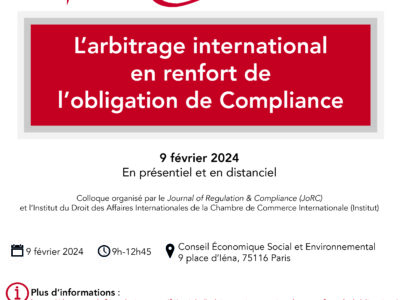
🎤Préalable : ce qu’est l’obligation de Compliance (Prerequisite: the Compliance Obligation), in 🧮L’arbitrage international en renfort de l’obligation de Compliance

► Full Reference: M.-A. Frison-Roche, "Préalable : ce qu'est l'obligation de Compliance" ("Prerequisite: the Compliance Obligation"), in L. Aynès, M.-A. Frison-Roche, J.-B. Racine and E. Silva-Romero (dir.), L'arbitrage international en renfort de l'obligation de Compliance (International Arbitration in support of the Compliance Obligation), Journal of Regulation & Compliance (JoRC) and Institute of World Business Law of the ICC (Institute), Conseil Économique Social et Environnemental (CESE), Paris, February 9, 2024 - 🧮see the full programme of this event - consult on LinkedIn a general presentation of this event, which links to a presentation of each speech (in French) - 🧱consult the scientific direction sheet of this event, which gives an account of the various speeches made - 🔲see the slides used to support the presentation (in French) - 🎤see a presentation of the conference "Préalable : ce qu'est un engagement" ("Prerequisite: the Commitment"), given at the same symposium - 🎤see a presentation of the conference "Le renforcement des engagements de Compliance par le renvoi Ex Ante à l'arbitrage international" ("Reinforcing Compliance commitments by referring Ex Ante to International Arbitration") which was finally not pronounced but will be the subject of an 📝article in the forthcoming book 📘Compliance Obligation  - ► Presentation of the conference: I have first dealt with the very definition of the Compliance Obligation. After showing that the relationship between Compliance Law and International Arbitration will naturally develop, because the companies subject to it are international, because they contractualise their legal Compliance obligations and because Compliance is being jurisdictionalised📎1🕴️M.-A. Frison-Roche (ed.), 📘Compliance Jurisdictionalisation, 2024., the arbitrator being the natural judge since he is a global judge and the judge of the contract, I pointed out that Compliance Law does not simply entrust arbitration with the task of preventing evils, such as corruption pacts, but that it creates positive obligations for companies: to detect and prevent behaviour whose systemic effect is deleterious. This culture of compliance is achieved either through compliance contracts📎2🕴️M.-A. Frison-Roche, 🚧Compliance contract, compliance clauses, 2022. (which outsource the handling of audits, alerts, the drawing up of plans, etc.), or through compliance clauses📎2🕴️M.-A. Frison-Roche, 🚧Compliance contract, compliance clauses, 2022., which are inserted into distribution or supply contracts, etc.; arbitration clauses are linked to these. Thus, the alliance between Compliance and Contract is an indirect mode of alliance between Arbitration and Compliance Obligation. The obligation of Compliance which then takes concrete form consists for the company not in making effective Ex Ante all the regulations which apply to it (conception of conformity which is at once unreasonable, blind and impossible), but in making its best efforts, which it must make visible (see Compliance Evidence System📎3🕴️M.-A. Frison-Roche, 📝The Judge, the Compliance Obligation and the Company. The Compliance Evidence System, in 🕴️M.-A. Frison-Roche (ed.), 📘Compliance Jurisdictionalisation, 2024.) to achieve Monumental Goals. These Monumental Goals are systemic. The aim is to protect systems from collapse (Negative Monumental Goals) or to make them better (Positive Monumental Goals)📎4🕴️M.-A. Frison-Roche, 📝Compliance Monumental Goals, Beating Heart of Compliance Law, in🕴️M.-A. Frison-Roche (ed.), 📘Compliance Monumental Goals, 2023.. By making companies accountable, via this Ex Ante Law whose object is the future, the systemic evils of corruption, money laundering, discrimination, climate change and hatred are combated, thus finding substantial unity. The Positive Monumental Goals aim to engender sustainability, security, respect for human beings, etc. in systems, be they banking, financial, digital, climatic, etc. The role of the Judge, and therefore also that of the Arbitrator, is renewed.

Conferences

🎤Le renforcement des engagements de compliance par le renvoi Ex Ante à l’arbitrage international (Reinforcing Compliance commitments by referring Ex Ante to International Arbitration), in 🧮L’arbitrage international en renfort de l’obligation de Compliance

► Full Reference: M.-A. Frison-Roche, “Le renforcement des engagements de Compliance par le renvoi Ex Ante à l’arbitrage international” (“Reinforcing Compliance commitments by referring Ex Ante to International Arbitration”) (planned but not delivered), in L. Aynès, M.-A. Frison-Roche, J.-B. Racine and E. Silva-Romero (dir.), L’arbitrage international en renfort de l’obligation de Compliance (International Arbitration in support of the Compliance Obligation), Journal of Regulation & Compliance (JoRC) and Institute of World Business Law of the ICC (Institute), Conseil Économique Social et Environnemental (CESE), Paris, February 9, 2024 - 🧮see the full programme of this event - consult on LinkedIn a general presentation of this event, which links to a presentation of each speech (in French) - 🧱consult the scientific direction sheet of this event, which gives an account of the various speeches made - 🔲see the slides that were to support the presentation (in French) - 📝This conference, which was to be delivered, and the Working Paper on which it is based are to be linked with the article to be published in the book📘Compliance Obligation  - 🎤see a presentation of the conference “Préalable : ce qu’est l’Obligation de Compliance” (“Prerequisite: what is the Compliance Obligation”), given at the same symposium - 🎤see a presentation of the conference “Préalable : ce qu’est un engagement” (“Prerequisite: the Commitment”), given at the same symposium - ► Presentation of the conference: It was initially planned that I would speak on the subject Le renforcement des engagements de Compliance par le renvoi Ex Ante à l’arbitrage international (Reinforcing Compliance commitments through the Ex Ante referral to International Arbitration), but it was agreed with the other organisers of the symposium that after defining the concept of the Compliance Obligation📎1🕴️M.-A. Frison-Roche, 🎤Préalable : ce qu'est l'obligation de Compliance (Prerequisite: the Compliance Obligation), in 🧮L'arbitrage international en renfort de l'obligation de Compliance (International Arbitration in support of the Compliance Obligation), 2024. I would refocus my second speech, mentioned above, on what a Commitment is📎2M.-A. Frison-Roche, Préalable : ce qu'est un engagement 🕴️M.-A. Frison-Roche, 🎤Préalable : ce qu'est un engagement (Prerequisite: the Commitment), in 🧮L'arbitrage international en renfort de l'obligation de Compliance (International Arbitration in support of the Compliance Obligation), 2024., an essential prerequisite for dealing with the subject of International Arbitration in support of the Compliance Obligation. Developments on Reinforcing Compliance commitments through the Ex Ante referral to International Arbitration will appear in the forthcoming books: L’obligation de Compliance (in French), Compliance Obligation (in English). Nevertheless, if I had dealt with this subject, I would have raised the following points: I would have shown that the inclusion of an offer of arbitration in the field of Compliance implies considering it in a contract as well as in a non-contractual commitment, and studying which category of Compliance Obligation the offer may apply to. I would have added that this insertion benefits from taking the form of a “graduated offer”, in a crescendo organised by the company ex ante and offered to the stakeholders: conciliation, mediation and arbitration, in “circles of trust”📎3🕴️M.-A. Frison-Roche, 🚧Compliance and Trust, 2017.. This is supported by the current French amicable settlement policy. The result was that I had to prepare a long “preliminary” discussion of what a “commitment” is, without which it seemed difficult to talk in concrete terms about the effective insertion of an offer of arbitration if we did not know whether such links or words had a constraining effect on the person issuing them in relation to the person benefiting from them. After discussions with the other speakers, it became clear that it would be more effective to give a talk devoted solely to the question of the legal definition of commitment. We therefore decided to allocate this second speaking slot to the notion of commitment. Since the written words do not have the same constraints, it will take up the initial construction, insisting on the different supports, either compliance contracts, or associations with compliance clauses, relating to different Compliance obligations, in particular on information or audit or Vigilance📎4🕴️M.-A. Frison-Roche, 🚧Compliance contract, compliance clauses, 2022., because the company must have the legal power corresponding to the mission that the State entrusts to it through Compliance📎5🕴️M.-A. Frison-Roche, 🚧Conceiving Power, 2021.. The offer must be carefully drafted to explain its purpose, and its organisation must prove the reality of this purpose: to give access to a judge to people affected by the company’s activity, and not to block it. This will therefore be available in detail in the forthcoming books: M.-A. Frison-Roche (ed.), 📕L’obligation de Compliance M.-A. Frison-Roche (ed.), 📘Compliance Obligation

Conferences

🎤Préalable : ce qu’est un engagement (Prerequisite: the Commitment), in 🧮L’arbitrage international en renfort de l’obligation de Compliance

► Full Reference: M.-A. Frison-Roche, "Préalable : ce qu'est un engagement" ("Prerequisite: the Commitment"), in L. Aynès, M.-A. Frison-Roche, J.-B. Racine and E. Silva-Romero (dir.), L'arbitrage international en renfort de l'obligation de Compliance (International Arbitration in support of the Compliance Obligation), Journal of Regulation & Compliance (JoRC) and Institute of World Business Law of the ICC (Institute), Conseil Économique Social et Environnemental (CESE), Paris, February 9, 2024 - 🧮see the full programme of this event - consult on LinkedIn a general presentation of this event, which links to a presentation of each speech (in French) - 🧱consult the scientific direction sheet of this event, which gives an account of the various speeches made - 🔲see the slides used to support the presentation (in French) - 🎤see a presentation of the conference "Préalable : ce qu'est l'Obligation de Compliance" ("Prerequisite: what is the Compliance Obligation"), given at the same symposium - 🎤see a presentation of the conference "Le renforcement des engagements de Compliance par le renvoi Ex Ante à l'arbitrage international" ("Reinforcing Compliance commitments by referring Ex Ante to International Arbitration") which was finally not pronounced but will be the subject of an 📝article in the forthcoming book 📘Compliance Obligation  - ► Presentation of the conference: Having defined the Compliance Obligation in "Préalable : ce qu'est l'Obligation de Compliance" ("Prerequisite: what is the Compliance Obligation"), I set out to define what a commitment is. No one doubts that commitments, as words, constitute facts that can engage the liability of companies if there are inconsistencies or lies. The question today is whether a commitment can constitute a legal act, binding in ex ante. Companies make commitments either to fulfil their legal Compliance obligations, which is simply obeying the law, or to express their own wishes, either for themselves or for others. The cases are often confused, even though the scope is not the same. If the commitment takes the form of a contract, Compliance is concerned if the contract is used as an Ex Ante Compliance Tool📎1🕴️M.-A. Frison-Roche (ed.), 📘Compliance Tools, 2021., either if the entire contract has this purpose, or if a compliance clause is inserted, and an arbitration clause may be linked to it. The commitment, a concept that comes more from the Economics of Regulation, was conceived between a Regulatory Authority and a Company: it is the unilateral decision of the Authority that gives legal force to the commitment. Case law confirms this (Conseil d'État (French Council of State)📎2🏛️Conseil d'État (French Council of State), 21 April 2023, No. 464349, Sté Orange v. Arcep. and Conseil constitutionnel (French Constitutional Council)📎3🏛️Conseil constitutionnel (French Constitutional Council), 19 March 2021, decision No. 2021-891 QPC, Association Générations futures et autres.) and this is particularly clear in Competition Law, but it is also true of the convention judiciaire d'intérêt public – CJIP (French Judicial Public Interest Agreement). If commitment is central to Compliance, particularly Vigilance, it is because Compliance Law is an extension of Regulatory Law📎4🕴️M.-A. Frison-Roche, 🚧From Regulation Law to Compliance Law ; 🚧Compliance Law loses the ties of Regulation Law but retains its principles: consequences for companies, 2018 ; 🚧The deployment of Regulatory Law through Compliance Law in the European project, 2023.. The company is forcibly instituted by the Compliance regulator, particularly in value chains, or on digital spaces (DSA). In drawing up a plan, the company is fulfilling its legal obligation. But if we were to consider that it is a commitment, then we would also have to consider that the plan is the result of its will, that it must consult the stakeholders in its preparation, but that the source of the plan is its will: the provisions are not stipulations, are not applications of the law, but unilateral voluntary provisions. In this respect, and because its source is the will of the company (which does not prevent its co-construction), a plan could contain a "graduated offer" of arbitration. This offer could be included in commitments that are less regulated by law, such as those made in the context of CSR.

Conferences

conference

🎤Conclusions, in 🧮le devoir de vigilance des entreprises : l’âge de la maturité ?

flollow Marie-Anne Frison-Roche on LinkedIn subscribe to the Newsletter MAFR Regulation, Compliance, Law  - ► Full Reference: M.-A. Frison-Roche, "Conclusions", in Ch. Maubernard et A. Brès (dir.), Institut de droit européen des droits de l'homme et Centre de droit de l'entreprise, Université de Montpellier, Le devoir de vigilance des entreprises : l'âge de la maturité?("The Entreprises duty of vigilance: the maturity age?") , Montpellier, May 25, 2023. The conference is held in French. - 🧮see the manifestation programme (in French) - read the report done on LinkedIn (in French) - ► English summary of this final speech of the manifestation: It is rather difficult to draw a conclusion after listening so many contributions. For three reasons: firstly, because of their richness and extreme diversity; secondly, because of the fact that we do not know whether the duty of vigilance is under the French law of 2017 (known as the Vigilance Law) or in other national, European and international texts or beyond or below the legal rules; thirdly, because we do not know what is meant by the "maturity" of a legal concept. But in the end, since the question posed by the title itself of the colloquium is Duty of Vigilance: the age of maturity? the answer is clearly: no. But this is regrettable. It is therefore essential to explore the ways in which the duty of vigilance can mature.  If we find merit in this duty which has now entered the legal system, there are eight intersecting avenues, which must be exploited. The first path is progression through the passage of time, rediscovering what in the past was already vigilance and what in the future will be its deployment. The second way is to progress by fixing the vocabulary, because we are witnessing a great battle of words, overtly or covertly, in French or English. The third path is progression through the emergence of principles, or even a principle, rediscovered or invented. The fourth path is progression through coherence brought to the legal system(s), which at present suffer from gaps and inconsistencies, which could be remedied by methods such as centralising litigation or, more radically, ignoring borders. The fifth path is progression through the fact that it works, because vigilance techniques are those of Compliance, of which vigilance is the leading edge, and the challenge is to find solutions. The sixth path is progression through using power of the legal system not only to create new areas of relevance – starting with the notion of vigilance, but also that of the value chain – but also to impose new indifferences, namely indifference to the figure of the market (to which laws prefer the company and the value chain) and indifference to borders. The seventh path is progression through bringing perspectives closer together, in order to find solutions even when interests are opposed. This is where the two techniques of contract and mediation are very welcome. The eighth path is progression through culture, because the culture of vigilance, like the culture of compliance, must be developed within companies and supply chains, and must become common to them and their stakeholders. - 🚧read the Working Paper written just after this oral conclusion in preparation for the article to be published. -  

Conferences

🖥️Propos introductifs : Les buts monumentaux de la vigilance, in🧮La société vigilante

🌐 follow Marie-Anne Frison-Roche on LinkedIn 🌐subscribe Newsletter MAFR Regulation, Compliance, Law  - ► Full Reference: M.-A. Frison-Roche, "Propos introductifs : Les buts monumentaux de la vigilance" (Introductory remarks: The Monumental Goals of Vigilance), in La société vigilante ("The Vigilant Company"), Aix-Marseille University, Institut de Droit des Affaires, March 24, 2023. - This conference is done in French; read its English Summary below⤵️ 🧮see the complete program of the manifestation (in French) - ► English Summary of the conference: "Vigilance" is intriguing because, although it occurs in many branches of Law and is familiar in "banking compliance", in a form that is moreover reinforced since it is an obligation of vigilance on the part of the banker about a client whom he/she should "know", it is the "duty of vigilance" that made this notion famous. One could almost say scandalously famous because of a French law of 2017 that now bears its name, called the "Vigilance Law", whereas other laws bear the name of the minister who thought of it, which due diligence (vocabulary used for the European directive) does not erase.   The current challenge is to take the right measure of what "vigilance" is. Vigilance goes beyond the French Loi Vigilance, which is not enough to express what it is in its few dispositions. To say what it is in the legal system, to use it in practice, to propose the intellectuel legal exercice of qualification, Vigilance must be thought of in Compliance Law, of which it is both a "Tool" and the most advanced point, as shown by the European Directive, whose discussions during its elaboration show these design issues. Thus, like the whole of Compliance Law, Vigilance is understood, deployed, analysed and exercised through what underpins and gives meaning to all these constantly changing regulations, powers, and obligations, through Compliance Monumental Goals which give it stability and simplicity. This is the least that can be done in a mechanism that has the ambition to organise the "sustainability" of economic relations. But while Vigilance expresses and concretizes Compliance Monumental Goals, it must not go beyond measure. In fact, to set up structures, use tools and behave in such a way that human rights and nature are effectively and extraterritorially protected, both negatively and positively, these obligations of the company, which is the natural subject of the "duty", more generally the natural subject of Compliance Law, see its legal powers increased, these means being required for the company to fulfil its new obligations, first legal, then contractual, soon to be unilaterally formulated. Perhaps we should conceive of a "vigilant company" and not just a company that, beyond and through its economic activity, cares for others and the world, but a company that "watches over" everything and on everything would be to go beyond the measure, to make companies the "regents" of the world and the people who live in it. Faced with this perspective to be excluded, the construction of a Europe of Compliance, which does not be reduced to corruption fighting or environment protection, and draws on its humanist tradition, distinguishing itself in this respect from the American and Chinese compliance systems, is the major challenge.  Companies are not the alpha and omega, but they are one of the elements of an Alliance between the political Authorities and the population, its link, the one that allows us to escape from the limit of the territory, in what we call by this inadequate term of "extraterritoriality". It is rather a question of going beyond territories, required by the Compliance Monumental Goals of Compliance, of which Vigilance is the advanced point. - 🚧read the English Working Paper, basis of this conference: "Vigilance, Compliance Monumental Goals, and "Vigilant Company"" - 📈see the slides created for this conference (in French) - 📝read the article published after this conference -