Organisation of Academic Events Related to Economic Law and Regulatory and Compliance Law

Organisation of events

⚙️scienfica organisation of a public manifestation

🧱Scientific Organisation of the Conference 🧮L’office du juge et les causes systémiques (“The office of the judge and systemic causes”)

► Full Reference: Frison-Roche, M.-A., coordination and moderation of the conference L'office du juge et les causes systémiques (""The Office of the Judge and systemic causes"), in Cycle of Conferences, Penser l'office du juge ("Thinking the Office of the Judge"), Grand Chamber of the Cour de cassation, Paris, May 9, 2021, 17h-19h. The conference is held in French. - ► General presentation of the conference: the conference is based on the intervention of three judges, Christophe Soulard, Fabien Raynaud, and François Ancel, who think and debate among themselves on a hypothesis: the existence of "systemic causes". The hypothesis is that beyond and through the diversity of disputes and cases that are submitted to the most diverse judges, there is a category of cases that are systemic, which means containing in what is submitted to the judge for resolution a system.  If such a category exists, which also raises the question of the diversity of systems and the difficulty arising from their submission to rules that are not legal (for example economic, biological, financial "laws", etc.) , then the judge should take this into account, both in the procedure and in the judgment they make on the case and in the way they formulate et restitute this judgment. - 📝read the presentation of this conference by the Cour de cassation (in French) 📝read the program of the cycle of conferences 2022 (in French) -  🎥see the conference video (in French)  🎥 see the synthesis video of the conference, made in situ by Marie-Anne Frison-Roche (in French)   - ​✏️read the notes taken during the conference to make the synthesis (in French) 📝read the article of Marie-Anne Frison-Roche restituting this conference, published in the Recueil Dalloz (in French) - ►read the works, basis of the two interventions of Marie-Anne Frison-Roche 🚧 L'hypothèse de la "cause systémique (made before the conference to prepare it), available en English 📝Synthese of the conference (made during the conference) -

Organisation of events

📅 Scientific Co-organization of the colloquium “Radioscopie d’une notion : les “buts monumentaux” de la Compliance (“Radioscopy of a notion: the Compliance “monumental goals””), in “Les buts monumentaux de la Compliance” (“Compliance Monumental Goals”)”

► co-organized between Laboratoire DANTE and the Journal of Regulation & Compliance (JoRC), this colloquium) is the core manifestation of the 2021 series of colloquia devoted to the general theme of Compliance Monumental Goals. It will take place on 16th of September 2021, at the Maison du Barreau, in Paris. This first work is in French but  will be the basis of the book in English : Compliance Monumental Goals,    This book will be published in the Compliance & Regulation Series, co-published by the JoRC and Bruylant. ► Presentation of the colloquium Thematic: To understand the notion of "Monumental Goals", it is firstly necessary to take crossed perspectives on them, particularly through the prism of Labor Law, Environmental Law and Enterprise Law. Many questions appear. Does the notion of “Monumental Goals” present any substance in Law? Is it uniformly understood, or do specificities appear, forged by specific cultures and disciplinary practices? What are the sources and implicit references or echoes? Because even if we admit the part of novelty, there is undoubtedly an anchoring in traditional legal concepts, like the general interest or sovereignty. How does the shift from meta-legal (prima facie introduced by the concept) to legal take place, and where do any operational difficulties lie when legal actors are called upon to act? The question of a possible categorization of "Monumental Goals" will thus be explored, through these three legal disciplines whose historicity, goals and implications for firms differ.   These reflections allow to ask why and how these "Monumental Goals" are developed. Indeed, what is the relevance of the association of "Monumental Goals" and Compliance? Beyond theoretical considerations relating to the meaning of Law, is this really an effective alloy encouraging companies to behave differently? By what ways? These questions arise in particular with regard to the imperatives of legal certainty and the operative nature of the concept. The question of "Monumental Goals" will thus be explored by the operational actors of compliance, both those who act within companies and those who act from the lato sensu State sphere, for understanding whether this notion is a pure rhetoric figure or constitutes a particularly promising lever for the evolution of market behavior.   ► with :  🎤 Christophe André, maître de conférences à l'Université Paris – Saclay (lecturer at the Paris-Saclay University) 🎤 Guillaume Beaussonie, professeur à l'Université Toulouse-1-Capitole (law professor at Toulouse-1-Capitole University) 🎤 Regis Bismuth, professeur de droit à Sciences po, Paris (law professor at Sciences po Paris) 🎤 Marie-Emma Boursier, doyen  de l'Université Paris – Saclay (dean of the Paris-Saclay University) 🎤 Muriel Chagny, professeur l'Université Paris – Saclay, directrice du Laboratoire Dante (Professor at the Paris-Saclay University, director of the Laboratory Dante) 🎤 Marie-Anne Frison-Roche, professeur à Sciences po (Paris) (Professor at Sciences Po Paris) 🎤 Isabelle Gavanon, avocate à la Cour d'Appel de Paris (attorney before the Paris Court of Appeal) 🎤 Emma Guernaoui, ATER à l'Université Paris II Panthéon-Assas (ATER at Paris II Panthéon-Assas University) 🎤 Dominique Heintz, avocat à la Cour d' appel de Paris (attorney before the Paris Court of Appeal) 🎤 Christian Huglo, avocat à la Cour d' appel de Paris (attorney before the Paris Court of Appeal) 🎤Dominique de La Garanderie, avocat à la Cour d'appel de Paris (attorney before the Paris Court of Appeal)  🎤 Anne-Valérie Le Fur, professeur à l'Université Paris – Saclay (Professor at Paris-Saclay University) 🎤 Anne Le Goff, secrétaire générale déléguée d'Arkéa (Deputy Secretary general at Arkéa) 🎤 Roch-Olivier Maistre, président du Conseil supérieur de l'audiovisuel (President of the French audiovisual regulation authority) 🎤 Marie Malaurie, professeur à l'Université Paris-Saclay (professor at the Paris-Saclay University) 🎤 Jérôme Marilly, avocat général à la Cour d'Appel de Paris (General attorney before the Paris Court of Appeal) 🎤 Benoît Petit, maître de conférences (HDR) à l'Université Paris-Saclay (lecturer at the Paris-Saclay University)  🎤 Jean-François Vaquieri, Secrétaire Général d'Enedis (Secretary General of Enedis) - Read a detailed presentation below:  
Organisation of events

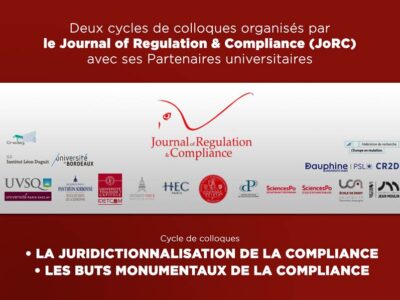
Organization and scientific co-direction of the cycle of colloquia : “The juridictionnalization of Compliance”

Like the precedent cycles dedicated to the general topic of Compliance, aiming to build a "Compliance Law" and aiming also to be published in the series Regulation & Compliance, coedited by the Journal of Regulation & Compliance and Dalloz, this cycle continues to deepen a specific aspect of this emerging branch of Law which has been applied before being designed.   The year 2020-2021 will give rise to two full and distinct cycles, the former deepening a key concept of Compliance Law, that are "monumental goals" and the later deepening a phenomenon with multiple roots and consequences: "the juridictionnalization of Compliance".  The juridictionnalization of Compliance is perhaps as ancient as Compliance mechanisms themselves.   These various conferences will take place in different places, according to the role played by the very numerous universities which, this year once again, support the Journal of Regulation & Compliance for the realization of this cycle. This cycle will give rise to two books, one in French: La Juridictionnalisation de la Compliance, and the other in English : Juridictionnalization of Compliance.  This cycle of colloquia The juridictionnalization of Compliance will start in October 2020 and will take place until December 2021.   Inaugural colloquium:  Compliance juridictionnalization: why? Who? How? Where? and Toward What? , organized by the JoRC under the scientific direction of Marie-Anne Frison-Roche : read more information here   Second Colloquium: 31st of March 2021 :  Arbitration and Compliance, co-organized by the JoRC and Paris II University, under the scientific direction of Marie-Anne Frison-Roche and Jean-Baptiste Racine : read more information here   Third colloquium : 23rd of June 2021 : The firm instituted as Court by Compliance Law, co-organized by the JoRC and the équipe de recherche Louis Josserand of Lyon 3 University, under the scientific direction of Marie-Anne Frison-Roche and Jean-Christophe Roda : read more information here    Fourth colloquium: September 2021 :  Which judges for Compliance? , co-organized by the JoRC and the CR2D of Paris-Dauphine University, under the scientific direction of Marie-Anne Frison-Roche and  Sophie Schiller : read more information here ​ Fifth colloquium: October 2021 :  Compliance Law, crucible between American Procedure Law and Procedure Law, co-organized by the JoRC and the Brussels University, under the scientific direction of Marie-Anne Frison-Roche and Arnaud van Waeyenberge: read more information here   Sixth colloquium:  Proportionnality, Compliance balance, co-organized by the JoRC and IDETCOM of Toulouse University, under the scientific direction of Marie-Anne Frison-Roche and Lucien Rapp: read more information here

Organisation of events

Organization and scientific codirection of the cycle of conferences “Les outils de la Compliance” (Compliance Tools)

As the previous cycles devoted to the general theme of Compliance and aiming to build a "Compliance Law", having the same vocation to be published in the series Regulation & Compliance, co-published by the Journal of Regulation & Compliance (JoRC) and the Editions Dalloz, this cycle takes a particular aspect of this branch of the Law being built and developed, which was applied even before being conceived. Since pragmatism preceded or even prevailed, the theme chosen this year is: Les outils de la Compliance (Compliance Tools). These conferences will be in French These tools are very diverse, not only among themselves but according to the sectors in which they are deployed or according to the geographical areas in which they are applied. It is necessary to apprehend them by going beyond the description of the instrument literally shown, as the texts or the promoters show it, without immediately going up to too large  generalities. For this reason, some conferences will focus on specific, well-identified mechanisms, such as risk mapping or alert. They may also consider how Compliance Law uses more general tools to achieve its goals, such as lawsuits, incentives or new technologies. This will make it possible to problematize more clearly perceptible difficulties in Compliance  Law, such as the adequacy or inadequacy of the constraint in relation to the aims, the consideration or not of the legal and political geography, the articulation or not of the tools between them. These various conferences will take place in several places, according to the part taken by the different university structures that this year contribute to the Journal of Regulation & Compliance (JoRC) for the realization of the cycle. The result will be two books, one in French: Les outils de la Compliance, the other in English: Compliance Tools.   This cycle of conferences about Compliance tools will begin in November 2019 and will last until June 2020.   First conference: 28 November 2019, La cartographie des risques (Risk Mapping), Sciences po. This conference will be in French. Its publication will be in French and in English. Conditions of inscription (in French).  Calendar of the entire conferences.     Le Journal of Regulation & Compliance (JoRC) works with :    The School of Public Affairs of Sciences Po, The Department of Economics of Sciences po, The  École de Droit of the Panthéon-Sorbonne University (Paris I), The École doctorale de Droit privé of Panthéon-Assas University (Paris 2), The Centre Perelman of l'Université Libre de Bruxelles, The GREDEG of the Sophia-Antipolis University (Nice), The Centre Louis Josserand of the Faculté Lyon III. The Faculté de Droit of Toulouse, TheFaculté de Droit of Clermont-Ferrand.     This cycle of conferences is supported by : The Chambre de Commerce et d'Industrie de Paris. The Ecole de Formation du Barreau de Paris.