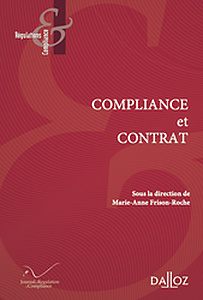
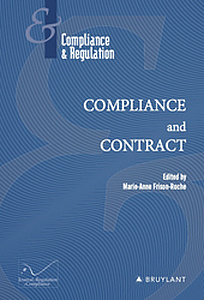
Compliance and Contract

Séance du colloque « La contractualisation de la Compliance : clause après clause », Université Jean Moulin Lyon 3, 25 septembre 2026

Articles

Article in a MAFR newsletter

📝From Clause to Clause: the Emergence of a Contractual Compliance System

► Full reference: M.-A. Frison-Roche, “From Clause to Clause: the Emergence of a Contractual Compliance System”, Newsletter MaFR Law, Compliance, Regulation, 30 September 2026 (linkedin.com/pulse/from-clause-emergence-contractual-compliance-system-marie-anne-v52ie/) - 🌐 read the article published on LinkedIn - 📧 read other issues of the Newsletter MAFR – Law, Compliance, Regulation by free subscription - 🧮 read the presentation of the colloquium “La contractualisation de la Compliance : clause après clause” (Lyon, 25 September 2026) - 🏗️ read the presentation of the 2026 cycle of colloquia Compliance and Contract - 📕 read the presentation of the book Compliance et Contrat - 🇫🇷 read the French version of this newsletter - 📝 ⤵ read the article below ⤵

Conferences

Conference

🎤Considérer la géographie pour réussir le Devoir de Vigilance (Taking Geography into account for a successful Vigilance Duty), in 🧮Devoir de vigilance, quelles perspectives africaines ? Regards croisés en droit international, droit comparé et droit OHADA

► Full Reference: M.-A. Frison-Roche, "Considérer la géographie pour réussir le Devoir de Vigilance" ("Taking Geography into account for a successful Vigilance Duty"), concluding speech in Devoir de vigilance, quelles perspectives africaines ? Regards croisés en droit international, droit comparé et droit OHADA (Vigilance Duty : what African perspectives? Cross-analysis of International Law, Comparative Law and OHADA Law), Institut de Recherche en Droit des Affaires et du Patrimoine (IRDAP), Bordeaux, 15 November 2024. - 🧮see the full programme of this manifestation (in French) - ► English summary of this concluding speech: This concluding speech was made "on the bench", i.e. directly after listening to all the day's speakers. It is not, therefore, based on an a priori conception of the subject, but on the impression that emerged from the whole, as one speaker followed another. The general impression is that these compliance instruments, of which the vigilance tool is the spurred head, are only appropriate if they fulfill the purpose for which they were devised and imposed, which presupposes that they are appropriate to the concrete situations to which they apply: to the country, to the legislation that shapes and expresses this country, to its economy, to its population. There is certainly room for improvement. But Vigilance legal instruments, like Compliance Law, are new mechanisms that are in the process of taking shape: we must seek to improve them and find solutions: 🧱🕴🏻mafr, 🚧Duty of Vigilance: the way forward, 2024   This is not easy, especially if we get lost in the jigsaw puzzle of texts and decisions in which the vigilance technique fits, particularly at French, European and international level: 🧱🕴🏻mafr, 🚧Vigilance, a piece of the European puzzle, 2023   Listening to all the many and varied speakers, it is clear that progress needs to be made to ensure that the Vigilance instrument takes greater account of the concrete situations reflected in the various legal systems of African countries, and in particular the unified OHADA legal system. It can be done, as long as everyone is willing to bear it in mind. 🧱🕴🏻J.-B. Racine, 📝Geographical dominance in the choice and the use of compliance tools. Introductory remarks, in 🧱🕴🏻mafr (ed.), 📘Compliance Tools, 2021   The speakers demonstrated that the good feelings of Paris or Brussels can pave the way for African hell, for example when about the children labour. The same is true of the fight against corruption, as Mohamed Salah showed. 🧱🕴🏻M.M. Salah ,📝Conception and Application of Compliance in Africa, in 🧱🕴🏻mafr (ed.), 📘Compliance Tools, 2021 - Meanwhile, listening to each other, it appears that often, despite using the same words, the speakers were not talking about the same thing, particularly not in terms of what the very term "Vigilance" refers to, the difference between the French and English being a challenge because "due diligences" are not the same than Vigilance duty . This is a sign that what we call a duty, or an obligation, or a spontaneous commitment, or a legal order criminally sanctioned, which are not at all the same thing, shows the immaturity of this notion of "Vigilance". What's more, we sometimes talk about the climate, or human rights, or the need to fight corruption or money laundering. These latter concerns are undoubtedly covered by texts classified under Compliance Law, some of which assert that Vigilance is the cutting edge, while others claim that Compliance is alien to or merely a component of Vigilance, because Vigilance embraces ethics, while Compliance is merely obedience to the norm ('conformity'). It is clear that the absence of an agreement on definitions is a handicap in practice, as we do not know which legal regime will apply. This uncertainty is problematic in practice because the regulations don't  lay down definitions which alone make it possible to deduce the outline of the obligations of each party, particularly not those of the companies, which ask for instructions for use. Companies receive contradictory interpretations for the same situation, depending on who you are dealing with (a regulator or an NGO for example) or depending on the text (a text specific to the industrial activity, a text specific to the country, or a text from the country of the ordering company on the duty of vigilance, or a text from ordinary contract law or a text that will come from a soft law that remains rather mysterious).   This uncertainty feeds the passion that surrounds the issue of vigilance, with everyone speaking out, the specialists who want to talk about it being suspected of being a technocrat or captured, and those who don't speak out being the local population for whom others speak out. As a result, two phenomena are set to persist, which we had hardly anticipated but which are set to increase: the contractualisation of all vigilance mechanisms and the jurisdictionalisation of all vigilance organisation. - The first phenomenon is the contracting of Vigilance. This contractualisation is the means by which companies have been carrying out their legal compliance obligations for years, using a contractual art that is becoming increasingly sophisticated. We have very little information on these contracts, which are nonetheless what allow companies to obey the regulations and also to add to them, a combination of obedience and contractual freedom, the effects of which in practice have not yet been fully measured. 🧱🕴🏻mafr, 🚧Will, Heart and Calculation, the Three Traits Encercling the Compliance Obligation, 2024 🧱🕴🏻mafr (ed.), 📘Compliance and Contract, 2025   But they do raise essential questions. Firstly, they will bring back the jurisdiction of general courts , for example the commercial courts (tribunaux de commerce) in France, and the courts of the countries where the industrial operations take place: moreover, they are the natural route to international arbitration. They are a new type of contract, since they structure "value chains" (a managerial concept). 🧱🕴🏻mafr, 🚧Compliance Contract, Compliance Clauses, 2022   There are two key issues concerning these contracts: they directly concern African countries, their economic activity and their populations, as described throughout all the speeches. The first is to know who governs the structural apparatus constituted by these 'regulatory contracts' through which chains of activity are built as durable structures. Who is strong and who is weak, between companies and states? The second is to find out how much of the reality of the country and of local economic activity is taken into account by the subsidiary, and how much consideration is given to the local people involved: are the people who are actually involved really "taken into consideration" when we speak for them? Who is best placed to speak on their behalf, to defend them, to get to know them? If we want to contextualise, refine and get to know the situation as closely as possible, in other words if we want to have definitions so that we know what we are talking about, but at the same time start from geographical and human realities, then it is the Judge who appears because the court starts from the facts. - This is the second phenomenon that has emerged and is set to increase: the jurisdictionalisation of Vigilance. 🧱🕴🏻mafr (ed.), 📘Compliance Jurisdictionalisation, 2023 This is understandable, since the judge is able to take cognisance of the facts, the situation in Uganda or Tanzania, and what is often referred to as the "extraterritoriality" of the Compliance mechanisms being thus compensated for. However, the exclusive jurisdiction of the Paris Court of First Instance (decided in France by a 2021 law) may become more difficult, as it is even further away from Africa than the ordering company is. But it is precisely the contract judges who can be called upon to rule on the basis of Contract Law. This central role of the judge raises a number of procedural difficulties that have either not yet been resolved, moreover are not still being perceive 🧱🕴🏻mafr (dir.), 🧮Le Droit processuel de la Vigilance (Vigilance Genreral Procedural Law), 2024   At the interface between procedure and substance, evidentiary issues require the development of a new evidentiary system. When the relevant facts are in Africa but the company accountable for them is in France under legislation adopted in Europe, this must be taken into account. 🧱🕴🏻mafr, 📝The Judge, the Compliance Obligation and the Company. The Compliance Evidence System, in 🧱🕴🏻mafr (ed.), 📘Compliance Jurisdictionalisation, 2023   What's more, since the Monumental Goal is to prevent, manage and detect risks, it is the future that is the main object of proof. A difficult subject by its very nature of the future, which calls for caution. Caution is to be expected from Judges, who may prefer the solution of an agreement: the contract and the commitment come back, for example through mediation, among the methods of conflict resolution. But as close as possible to where it happens, OHADA's courts can then be called upon to hear States and populations.   What is more, in contractualisation (at which point the two major phenomena, contractualisation and jurisdictionalisation, enter into a dialectic), the clauses work together to activate the natural judge of the international contract, including vigilance clauses: the international arbitrator. 🧱🕴🏻L. Aynès, 📝How international arbitration can reinforce the Compliance Obligation, in 🧱🕴🏻mafr (ed.), 📘Compliance Obligation, 2025   OHADA has institutional arbitration mechanisms. Now is the time to guide them so that they open up Africa to Vigilance and open up Vigilance to Africa. In concrete terms.


Publication director

🏗️ copublishing and direction of the collection: 📚Compliance & Regulation

📚Publication of:🕴️M.-A. Frison-Roche (ed.), 📘Compliance and Contract

► Full Reference: M.-A. Frison-Roche (ed.), Compliance and Contract, Journal of Regulation & Compliance (JoRC) and Bruylant, “Compliance & Regulation” Serie, to be published - 📘In parallel, the French version of this book, Compliance et contrat, is published in the Serie co-published by the Journal of Regulation & Compliance (JoRC) and Dalloz - 🧮This book comes after a cycle of symposiums organised in 2023-2024 by the Journal of Regulation & Compliance (JoRC) and its Academic Partners - ► General presentation of the book: - 📚This volume is one of a series of books devoted to Compliance in this series. ► read presentations of the other books of this Serie dealing with Compliance : further books: 🕴️M.-A. Frison-Roche (ed.), 📘Compliance Evidence System, 2025 previous books: 🕴️M.-A. Frison-Roche (ed.), 📘Compliance Obligation, 2024 🕴️M.-A. Frison-Roche (ed.), 📘Compliance Jurisdictionalisation, 2024 🕴️M.-A. Frison-Roche (ed.), 📘Compliance Monumental Goals, 2023 🕴️M.-A. Frison-Roche (ed.), 📘Compliance Tools, 2021 📚see the global presentation of all the books of the Serie. - 🏗️General construction of the book: ► General presentation of this book: The book, published in 2025 in the same series “Regulations & Compliance” series, demonstrates that the Obligation of Compliance—which falls upon crucial operators and those concerned with the future of systems and the present and future individuals involved in them—derives from laws and regulations, and is upheld by these operators themselves, regulators and judges. The role played by contracts has already been discussed therein, since contracts are both a means by which operators perform their legal compliance obligation and an autonomous source of obligation (which places the question of liability at the heart of the subject). This book specifically examines the role that contracts play and will play in the conception, development and implementation of Compliance Law. This aspect is underestimated because Compliance Law is often analysed through the prism of laws and regulations designed to achieve Monumental Goals set by states and public authorities, to the realisation of which systemic economic operations contribute through compliance tools, rather than through the actors themselves. When they do act, this is referred to outside the realm of Law, generally to Ethics. However, the Contract, the binding Ex Ante legal instrument par excellence, will play an increasingly significant role within global and interconnected compliance systems. In the European construction of Compliance Law, which places human beings at the heart of efforts to ensure the sustainability of systems, the Contract serves not only as the means by which the entity fulfils its legal obligations, forges relationships with stakeholders and implements the necessary innovations, but also as the means by which it exercises its autonomy to contribute to the realisation of the systemic ambitions in question, may go beyond public ambitions, enrich them, anchor them territorially, and identify them with its own activity and its overall corporate strategy, etc. To describe and anticipate the practice and rules that link Compliance Law and Contracts, the book first examines how this new branch of Law, insofar as it draws on the political ideas of the Social Contract, renews Contract Law by embedding it within the strategy of economic operators, a task made all the easier for them as they have built value chains through contracts. These are ‘regulatory contracts’. This demonstrates that Public Law Contracts exemplify the incorporation by General Contract Law of the overarching perspective of compliance, normatively anchored in the Monumental Goals (Title I). That explained, the book examines how General Contract Law interfaces with the techniques and objectives of Compliance Law. Whether through mandatory requirements, incentives or support, Compliance Law plays a role in contracts, helping to shape them in part, whether they relate to regulated or unregulated activities, with the points of contact with the principle of liberalism – and the limits to it – being determined by the courts. Conversely, however, General Contract Law contributes to Compliance Law and will do so increasingly. This applies equally to the stages of formation, execution, and sanctions, which may take the form of consolidations (Title II). In practical terms, the Contract itself serves as a Compliance Tool. As such, the company may choose to outsource the compliance function, which it is free to do provided it remains accountable for its performance to the legislator and the persons concerned: this is the concept of the ‘Compliance Contract’, which appears as a specific contract. Furthermore, compliance can be incorporated into multiple contracts—contractual arrangements through which the contracting parties establish one or more obligations that will facilitate or enhance their legal obligations. In doing so, legal entities exercise their freedom, as permitted by general law, as can be seen in practice “clause by clause”, and this is also recognised by the Regulator, Supervisor and/or Judge in light of the normative Monumental Goals of Compliance Law (Title III). Precisely, a new field of ‘contractual compliance litigation’ is emerging. The primary topic here is to examine contractual judicial disputes in which an element of Compliance Law features in the proceedings. Indeed, a dispute concerning a claim for mandatory execution, termination or contractual liability may involve, in the claim itself or in an procedural exception or defence raised, an element of compliance law, ranging from an allegation of lack of jurisdiction to a request for the court to take into account a systemic teleological norm that the contract judge should consider. Secondly, in certain emerging systemic compliance litigation, because the role of the judge is transformed and the procedure must be adapted, the contract appears as a particularly suitable tool, either as a ‘procedural framework’ through the contractualisation of the whole, or as a technique used in the strict sense, its ex ante nature allowing, in disputes concerning the future, the development of new adequate techniques (Title IV). - ► First presentation of the provisional Table of Contents  : - PROVISIONAL TABLE OF CONTENTS REPORTING ON CONTRACTUAL PRACTICES WITHIN THE COMPLIANCE SYSTEM AND ENHANCING ITS EFFECTIVENESS AND HUMANITY ♦️ The Marriage between Compliance and Contract, by 🕴️Marie-Anne Frison-Roche TITLE I. SOCIAL CONTRACT, COMPLIANCE LAW AND THE STRATEGY OF ECONOMIC OPERATORS CHAPTER I: SOCIAL CONTRACT AND COMPLIANCE LAW Section 1 ♦️ The Monumental Goals of Compliance, a guide to action for economic operators serving global policies, by 🕴️Marie-Anne Frison-Roche Section 2 ♦️ Compliance and the Social Contract, by 🕴️René Sève CHAPTER II: POLITICAL AMBITIONS AND CORPORATE STRATEGIES IN THE CONTRACTUAL ORGANISATION OF VALUE CHAINS Section 1 ♦️ sss Section 2 ♦️ sss, by CHAPTER III: PUBLIC CONTRACTS, PARAGONS OF THE INCORPORATION OF POLITICAL AMBITIONS INTO STRATEGIES AND OF THE ALLIANCE OF INSTITUTIONS Section 1 ♦️ Contractual instruments facilitating the insertion of the compliance obligation, by 🕴️Marion Ubaud-Bergeron Section 2 ♦️ Third-party assessment obligations in public contracts, by 🕴️Valentin Lamy Section 3 ♦️ Exemplarity in public contracts, by 🕴️Ugo Assouad and 🕴️Léon Boijout Section 4 ♦️ Is the duty of vigilance soluble in the law of administrative contracts?, by 🕴️Antoine Oumedjkane TITLE II. GENERAL CONTRACT LAW FACED WITH COMPLIANCE LAW CHAPTER I: DISTINGUISHING WHAT IS CONTRACTUAL FROM WHAT RESEMBLES IT IN THE COMPLIANCE SYSTEM Section 1 ♦️ Commitments, Contractualisation and Compliance, by 🕴️Marie-Anne Frison-Roche Section 2 ♦️ The functional contract, the contribution of general contract law to compliance requirements, by 🕴️Laurent Aynès CHAPTER II: WHERE GENERAL CONTRACT LAW CONTRIBUTES TO COMPLIANCE Section 1 ♦️ Regulatory contracts generated by compliance, by 🕴️Jean-Baptiste Barbieri Section 2 ♦️ Third parties to contracts that include a compliance dimension, by 🕴️Philippe Stoffel-Munck TITLE III. COMPLIANCE CONTRACT, COMPLIANCE CLAUSES CHAPTER I: THE “COMPLIANCE CONTRACT” Sub-chapter 1: THE EMERGENCE OF THE “COMPLIANCE CONTRACT” AND OF THE COMPLIANCE MARKET Section 1 ♦️ The industrialisation and outsourcing by the company of an essential function through the “compliance contract”, by 🕴️Étienne Maclouf and 🕴️Bruno Deffains Section 2 ♦️ Legal definition of the “compliance contract”, by 🕴️Marie-Anne Frison-Roche Sub-chapter 2: EXAMPLES OF “COMPLIANCE CONTRACTS” Section 3 ♦️ Internal investigation contracts, by 🕴️Dominique de la Garanderie Section 4 ♦️ Contracts concluded with audit firms, by 🕴️Antoinette Gutierrez-Crespin Sub-chapter 3: THE LAW’S RESPONSE TO THE INDUSTRIALISATION AND STANDARDISATION OF THE “COMPLIANCE CONTRACT” Section 5 ♦️ How competition law grasps the standardisation and industrialisation of the “compliance contract” in order to regulate, by 🕴️Jean-Christophe Roda Section 6 ♦️ The international aspects of the “compliance contract”, by 🕴️Jean-Baptiste Racine CHAPTER II: COMPLIANCE CLAUSES Section 1 ♦️ Uniqueness and Diversity of Compliance Clauses, by 🕴️Marie-Anne Frison-Roche Section 2 ♦️ Compared usefulness of conformity clauses and Compliance clauses, by 🕴️Jean-Christophe Roda Sub-chapter 1: COMPLIANCE CLAUSES CONCERNING INFORMATION Section 3 ♦️ Compliance clauses relating to the transmission of information, by 🕴️Thibault Duchesne Section 4 ♦️ Compliance clauses relating to confidentiality and the non-transmission of information, by 🕴️Jean-Christophe Roda Section 5 ♦️ Compliance clauses relating to audit, by 🕴️Marie-Anne Frison-Roche Sub-chapter 2: COMPLIANCE CLAUSES CONCERNING THE PERFORMANCE OF THE CONTRACT Section 6 ♦️ Compliance clauses relating to changes in circumstances, by 🕴️Julia Heinich Section 7 ♦️ Compliance clauses aimed at obtaining appropriate behaviour (the example of labour relations), by 🕴️Joseph-Antoine Morin Section 8 ♦️ Compliance clauses aimed at ensuring the effectiveness of risk management plans, by 🕴️Grégoire Leray Section 9 ♦️ Robustness clauses, by 🕴️Ludovic Pailler Sub-chapter 3: COMPLIANCE CLAUSES CONCERNING THE PREVENTION AND ANTICIPATED MANAGEMENT OF DISPUTES Section 10 ♦️ Compliance clauses relating to sanctions, by 🕴️Laura Sautonie-Laguionie Section 11 ♦️ Compliance clauses relating to remediation, by 🕴️Morgane Tirel Section 12 ♦️ Compliance clauses relating to procedure, expert evidence and pre-trial case management, by 🕴️Thibault Goujon-Béthan TITLE IV. CONTRACTUAL LITIGATION INVOLVING COMPLIANCE LAW CHAPTER I: IDENTIFYING CONTRACTUAL LITIGATION INVOLVING COMPLIANCE Section 1 ♦️ The emergence of contractual litigation involving Compliance through the convergence of fields, by 🕴️Marie-Anne Frison-Roche Section 2 ♦️ The singularity of contractual litigation involving Compliance, by 🕴️Thibault Goujon-Béthan CHAPTER II: COURTS SEISED AND NATURAL JUDGES OF CONTRACTUAL LITIGATION INVOLVING COMPLIANCE Section 1 ♦️ Ordinary courts and specialised courts in contractual litigation involving Compliance, by 🕴️Romain Raine Section 2 ♦️ From the criminal court to the civil court in contractual litigation involving Compliance, by 🕴️Alex Nicollet Section 3 ♦️ The supporting judge in contractual litigation involving Compliance, by 🕴️Fabrice Vert Section 4 ♦️ The arbitrator in contractual litigation involving Compliance, by 🕴️Cyril Nourissat CHAPTER III: THE PARTIES TO CONTRACTUAL LITIGATION INVOLVING COMPLIANCE Section 1 ♦️ Original and intervening parties, necessary parties, stakeholders: who are the legitimate parties?, by 🕴️Liza Veyre CHAPTER IV: THE PROCEDURAL HANDLING OF CONTRACTUAL LITIGATION INVOLVING COMPLIANCE Section 1 ♦️ Handling time in contractual litigation involving Compliance: from urgency to the long term, by 🕴️Marie-Anne Frison-Roche Section 2 ♦️ Contractualising pre-trial case management, a natural tool of contractual litigation involving Compliance, by 🕴️Thibault Goujon-Béthan Section 3 ♦️ Contractualising evidence in contractual litigation involving Compliance, by 🕴️Nicolas Ida Section 4 ♦️ The hearing in contractual litigation involving Compliance, by 🕴️Anaïs Danet CHAPTER V: THE JUDGMENT IN CONTRACTUAL LITIGATION INVOLVING COMPLIANCE Section 1 ♦️ The appropriate judgment in contractual litigation involving Compliance and its effective enforcement, by 🕴️Marie-Anne Frison-Roche and 🕴️Thibault Goujon-Béthan